Error loading page.
Try refreshing the page. If that doesn't work, there may be a network issue, and you can use our self test page to see what's preventing the page from loading.
Learn more about possible network issues or contact support for more help.
Title details for Four Lost Cities by Annalee Newitz - Wait list

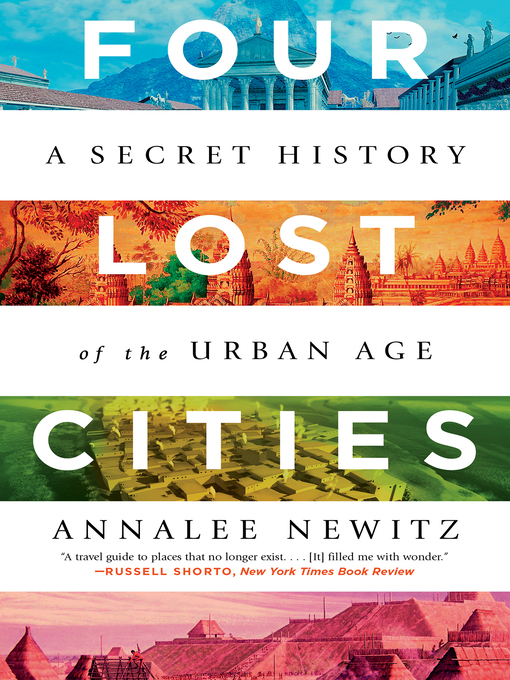
Four Lost Cities

A Secret History of the Urban Age

ebook
0 of 0 copies available

Named a Best Book of the Year by NPR and Science Friday

A quest to explore some of the most spectacular ancient cities in human history—and figure out why people abandoned them.

In Four Lost Cities, acclaimed science journalist Annalee Newitz takes readers on an entertaining and mind-bending adventure into the deep history of urban life. Investigating across the centuries and around the world, Newitz explores the rise and fall of four ancient cities, each the center of a sophisticated civilization: the Neolithic site of Çatalhöyük in Central Turkey, the Roman vacation town of Pompeii on Italy's southern coast, the medieval megacity of Angkor in Cambodia, and the indigenous metropolis Cahokia, which stood beside the Mississippi River where East St. Louis is today.

Newitz travels to all four sites and investigates the cutting-edge research in archaeology, revealing the mix of environmental changes and political turmoil that doomed these ancient settlements. Tracing the early development of urban planning, Newitz also introduces us to the often anonymous workers—slaves, women, immigrants, and manual laborers—who built these cities and created monuments that lasted millennia.

Four Lost Cities is a journey into the forgotten past, but, foreseeing a future in which the majority of people on Earth will be living in cities, it may also reveal something of our own fate.


  • Creators

  • Publisher

  • Release date

  • Formats

  • Accessibility

    The publisher provides the following statement about the accessibility of the EPUB file supplied to OverDrive. Experiences may vary across reading systems. After borrowing the book, you may download the EPUB files to read in another reading system.

    Ways Of Reading

    • No information about appearance modifiability is available.

    • Not all of the content will be readable as read aloud speech or dynamic braille.

    Conformance

    • No information is available.

  • Languages

  • Reviews

    • Publisher's Weekly

      October 12, 2020
      Science journalist Newitz (Scatter, Adapt, and Remember) examines the rise and fall of four ancient cities that “suffered from prolonged periods of political instability coupled with environmental crisis” in this energetic and intriguing account. Spotlighting Çatalhöyük, a Neolithic city found in present-day Turkey; the southern Roman city of Pompeii, which was destroyed in 79 CE by the eruption of Mount Vesuvius; Angkor, the capital of the medieval Khmer Empire in Cambodia; and pre-Columbian Cahokia in what’s present-day Illinois, Newitz visits each site and interviews archaeologists to explore how residents of these cities lived and died. Newitz ruminates on the experiences of “Dido,” a woman whose skeleton was found in Çatalhöyük, and the prostitutes who lived in the only “purpose-built brothel” in Pompeii; Newitz also recounts elaborate construction projects undertaken by Angkor’s kings and human sacrifices offered on large, earthen mounds in Cahokia. According to the author, the dismissive views of Western, Christian historians have obscured the ingenuity and agency of these ancient societies, whose strides in urban planning, contrasted with their social inequalities and political failings, offer lessons for today. Newitz skillfully fuses personal reflections with scientific observations, and offers a welcome tribute to the legacy of human resilience. This richly detailed, progressively minded history is worth exploring.

    • Kirkus

      November 15, 2020
      An exploration of four far-flung ancient cities, each undone by climate and politics. An alternate title for this book might be A People's History of Urbanism. Newitz is interested in how cities form, grow, and dissipate, and the author trains their focus on how everyday lives were affected by those processes. To do that, they select a quartet of once-mighty metropolises. Catalhoyuk, located in present-day Turkey 9,000 years ago, marked humanity's uneasy shift from farming communities to a dense city until sustained cold and drought unraveled the place. Pompeii was famously obliterated by a volcanic eruption in 79 C.E., but before it then exemplified a diverse society whose folkways survived beyond the city's ruins. Thailand's Angkor is known now for its majestic temples, but in the 13th century, those were just part of an agriculturally complex and sprawling region with a sophisticated infrastructure that was hard to maintain amid climate fluctuation and shaky leadership. Cahokia, located near present-day Saint Louis, was at its height (circa 1050 C.E.) an agricultural epicenter big on collective gatherings, fun and not (human sacrifices were common), until flood and drought likely took a toll. Newitz colors the narrative with accounts of personal visits to each site and interviews with the archaeologists there, many of whom debunk past scholars who looked at sites through a Western lens. (Not every naked female figurine represents a fertility goddess; not every successful society is rigidly hierarchical.) The author also attacks contemporary scholars like Jared Diamond, who argued that ancient civilizations collapse outright; more correctly, Newitz argues, multiple forces challenge and disperse communities. In an era of climate change, it's a hearteningly un-dystopian message but still a challenge to leaders to focus on "resilient infrastructure...public plazas, domestic spaces for everyone, social mobility, and leaders who treat the city's workers with dignity." A revealing look at the ancient past that speaks thoughtfully to the global-warming present.

      COPYRIGHT(2020) Kirkus Reviews, ALL RIGHTS RESERVED.

    • Library Journal

      December 1, 2020

      Newitz is an opinion writer for the New York Times and author of novels including Autonomous and The Future of Another Timeline. In this latest work, she takes a time-transgressive look at how centers of urban development rise, thrive, and die. Newitz focuses on four prehistoric urban centers in order to give readers an understanding that, despite differences in time, place, and complexity, urban societies share many similarities. Important urban centers considered are Catalhoyuk, Pompeii, Angkor Wat, and Cahokia. The author poignantly expresses the clear similarities of the "life and death" of these centers of urban development, but also ties them to our understanding of present-day centers of urban population and the complexities of their organization and decay. This book represents a real-time perception of the modern urban age and the lessons learned from prehistory. The author's observations are well-researched, current, and directly applicable to our modern lives. Four Lost Cities represents a contemporary companion to Elaine Morgan's Falling Apart, the Rise and Fall of Urban Civilization (1972). Those interested in prehistoric urban complexity, ancient civilizations, and world history will benefit from this new book. VERDICT An excellent contribution to literature on ancient civilization and complexity.--John Dockall, Austin, TX

      Copyright 2020 Library Journal, LLC Used with permission.

    • Booklist

      Starred review from December 1, 2020
      Journalist and author Newitz (The Future of Another Timeline, 2019) makes it clear that the titular phrase ""lost cities"" is misleadingly mythologizing. The urban spaces glowingly brought to life in these pages weren't lost, but rather declined or were abandoned, becoming stories and odd landmarks. Newitz speaks with many archaeologists and researchers who currently study the areas of Cahokia, Angkor, Pompeii, and �atalh�y�k. Their knowledge and enthusiasm are not only for the grand events of kings abandoning cities or catastrophic volcanic eruptions but also for the day-to-day details that bring the ancient world to life: decorations in the homes of �atalh�y�k, women who rented out shops and ran theater groups in Pompeii, farming and easily overlooked construction in Angkor, and gravel-covered public spaces in Cahokia where people experienced rituals as well as sporting events. But these cities ended. Newitz clearly draws parallels and lessons for the here and now from these once-vast settlements. We are not immune to natural disasters, political upheaval, and labor force abuses. What happens if cities become unlivable for too many? Highly recommended for anyone interested in that question and in what history can tell us about the possibilities for the future.

      COPYRIGHT(2020) Booklist, ALL RIGHTS RESERVED.

    • BookPage
      When Hurricane Katrina devastated New Orleans in 2005, thousands of people were forced to relocate. Some returned; others never did. As the city rebuilt, it changed, through both loss and revitalization. Fifteen years later, hurricanes still threaten New Orleans, but the city certainly endures. Keep that trajectory in mind if you ever visit a magnificent urban archaeological site such as Angkor Wat or Pompeii. As Annalee Newitz shows in the marvelous Four Lost Cities, an ancient city’s fate was determined by complex interactions of politics, the environment and human choices—all of which offer insight into the challenges of climate change and disease that we face today. Along with Angkor in Cambodia and Pompeii in Italy, Newitz’s four cities include Çatalhöyük in Turkey, the Neolithic site of one of the world’s first cities, and Cahokia, a Native American city that was located in the St. Louis metro region. Newitz takes us along on visits to all four locations, exploring their histories and cultures through interviews with the archaeologists doing cutting-edge research at each site. Spanning different epochs and continents, these cities were of course quite different during their respective eras. Angkor and Cahokia were essentially spiritual sites surrounded by low-­density sprawl; Pompeii and Çatalhöyük were densely packed. Pompeii was a trading town; the others were predominantly agricultural. But all faced significant environmental challenges, such as climate change, flooding, drought, earthquakes and volcanic eruption. What’s perhaps most astonishing is how long they lasted in the face of these calamities. Like New Orleans, they were rebuilt, time after time, by their creative, adaptable citizens. Through this brightly written, lucid narrative, Newitz shows us that these cities were never “lost” and rediscovered. Even when their people ultimately moved on, they took their cultures and memories with them. As we struggle with our own difficult urban realities, Newitz argues, it’s worth considering their resilience.

Formats

  • OverDrive Read
  • EPUB ebook

Languages

  • English

Loading